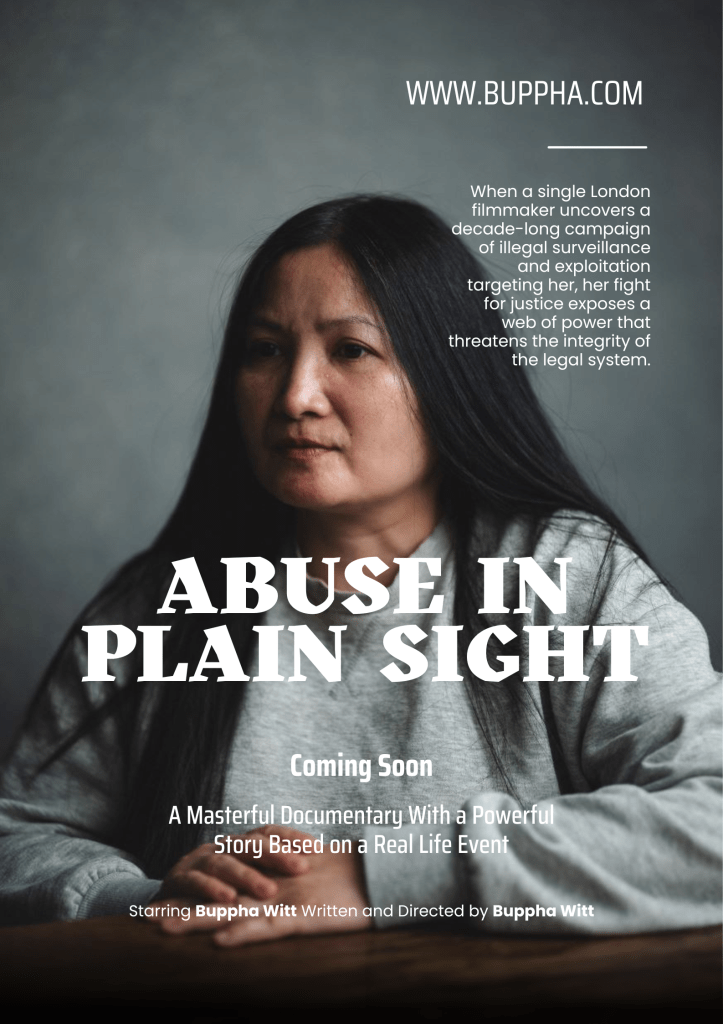
Logline: After filing a formal complaint against two police officers, PC Jonathan Miotti and PC Andrew Ngo, a single London filmmaker uncovers a decade-long campaign of illegal surveillance and exploitation targeting her—pulling her into a fight for justice that exposes a powerful, hidden system.
Synopsis: On 20 January 2023, Buppha Witt files a formal complaint against two police officers: PC Jonathan Miotti and PC Andrew Ngo.
Later that same year, around early August 2023, her 34-year-old daughter and her boyfriend of 12 years suddenly break up. She almost immediately starts seeing a new man from Spain she meets online, who has supposedly never been to her place. It’s always her who goes to visit him or they meet elsewhere for holidays together, strongly suggesting that he may know that there are hidden cameras in her place to sexually abuse and exploit her as well. Just like what they do to me.
On 30 August 2023, Buppha receives an update from the police on the progress of the complaint she made in January 2023.
In early October 2023, Buppha starts noticing signs that her and her daughter’s personal and sensitive information may be unlawfully obtained and misused / disseminated widely.
On 30 October 2023, Buppha receives an outcome of her police complaint made in January 2023, which is not upheld.
In or around October 2024, Buppha begins to uncover even more chilling clues that lead her to believe her private life has been non-consensually filmed and exploited for maybe over 10 years, with illegal footage allegedly live-streamed and monetized without her knowledge or consent.
Attempts to seek legal help are repeatedly blocked, including all her online activities and communications also seem to be unlawfully monitored at all times as if to prevent her from seeking help, leaving her isolated and fearful that powerful actors are working to silence her.
When she tries to consult legal professionals in person instead, Buppha experiences what she perceives as coordinated intimidation by unknown individuals, including men making shooting gestures with imitation firearms toward her in broad daylight causing her significant fear and persistent nightmares till this day!
Determined not to give in, Buppha takes action herself. In December 2024, she sends a cease-and-desist / pre-action protocol letter to the police she believes are centrally involved. No response follows, and even her follow-up is ignored.
Her fight to reclaim privacy and pursue justice has only just begun, setting the stage for a tense, urgent battle against a hidden network of abuse and obstruction of justice.
Hoping for respite, Buppha moves to Denmark—only to find the abuse follows her.
Back in the UK, she resolves to fight systematically, assembling evidence to apply for an injunction and initiate court proceedings. But each submission to the Royal Courts of Justice mysteriously vanishes, suggesting interference rather than error.
Relocating repeatedly, she believes every new residence—even shared hostels—has already been compromised, reinforcing her fear of constant monitoring and exploitation.
Every attempt to advance her case triggers escalated harassment and intimidation, while warnings are deleted, evidence tampered with, and her daughter may also be targeted.
Facing relentless abuse, blocked legal access, and escalating threats, Buppha hits rock bottom. Therefore, each step toward justice becomes a race against time, as she fights not only for herself but to protect her daughter and stop the hidden network determined to silence them.
Despite relentless surveillance, systemic sexual abuse, threats, and commercial exploitation, Buppha seizes control of her story through her blog and documentary, exposing systemic sexual abuse, the misuse of private information, and commercial profiteering on a massive scale, while her reputation, career, and livelihood appear sabotaged by repeated rejections and social ostracism. The fight for justice has thus inflicted personal, physical, and financial strain, yet she endures.
Determined to reclaim her life, she initiates court proceedings once more, fighting not just for justice but for survival.
Buppha’s fight is not yet over — but it doesn’t matter. She’s won back her confidence and is determined to fight for justice till the end.
In conclusion, Abuse in Plain Sight is an intimate, urgent investigation into severe privacy violation, abuse of power, gross human rights abuses and institutional failure, revealing the human cost of living under constant observation and exploitation.
Through profound trauma and the absence of legal representation, Buppha’s voice remains clear and resolute.
She fights not just for justice, but for her daughter—and for every woman left vulnerable.
Abuse in Plain Sight must end.
Justice & Fair Trial Focus
This documentary, like acclaimed investigative series Making a Murderer, examines systemic obstacles to justice. Central to the film is the protagonist’s repeated difficulty accessing legal representation, which she interprets as interference that could undermine a fair trial.
By documenting her struggle, the film highlights violations of fundamental human rights, including the right to legal counsel under Article 6 of the European Convention on Human Rights, and explores the broader consequences when institutional failures threaten due process.
The series places the audience in her perspective, showing the real-world impact of denied access to justice and the psychological weight of fighting legal battles without proper support – particularly against powerful actors.
Director’s Vision & Cultural Impact
My name is Buppha. I am an aspiring writer and filmmaker with over 20 years of experience both in front of and behind the camera, (ironically) mostly in front of the camera. I have independently written and directed 3–4 short films and am now ready to tell a deeply personal, feature-length story.
This documentary is, at its core, a film about voice — the fight to reclaim it, the forces that threaten it, and the courage required to speak when every system feels unresponsive. The protagonist, me, a Southeast Asian woman living alone in London, recounts years of digital intrusion, intimidation, and obstruction by individuals she perceives as powerful.
My vision is not to adjudicate these claims but to create a cinematic space where my lived experience can be expressed fully, honestly, and without distortion.
The film’s visual language mirrors the psychological landscape she describes: fragmented reflections, screens that glow in the dark, shadows that linger just a moment too long. These motifs evoke the emotional reality of feeling watched, unheard, and unprotected. The camera becomes both witness and companion — a counterweight to the sense of invisible observation she believes surrounds her.
Tonally, the film balances intimacy with investigation. Her voice anchors the narrative, guiding viewers through her fears, interpretations, and repeated attempts to seek justice.
Alongside her testimony, the documentary explores broader systemic issues: digital vulnerability, racialized targeting, institutional reliability, and the fragility of democratic safeguards. This dual approach ensures the story remains deeply personal while resonating with urgent global conversations about power, privacy, and accountability.
Central to the documentary is the struggle for legal and professional recognition. She recounts obstacles in accessing representation, interference with court filings, and the persistent sense that her daughter may also be at risk.
By allegedly preventing her from exercising her right to counsel, the system itself appears to enable ongoing harm, effectively obstructing a fair trial and violating fundamental rights under Article 6 of the European Convention on Human Rights. This case is therefore of urgent public interest, exposing how institutional failures can perpetuate abuse and compromise justice.
This documentary therefore examines systemic abuse and the obstruction of justice, showing how the protagonist’s repeated inability to access legal representation has allowed alleged perpetrators to continue exploiting and surveilling her, even while court proceedings are pending.
By documenting her journey, the film transforms trauma into testimony, exposing the human cost of prolonged, unlawful and intrusive surveillance, systemic obstruction, and the denial of due process.
The story also touches on racialized vulnerability and the exploitation of marginalized individuals, situating a deeply personal experience within pressing social debates about equity, privacy, and power.
A sophisticated pattern of harassment extends beyond direct actions, involving third parties who are allegedly influenced through unlawful monitoring of her online communications, creative works, and legal strategies. The deliberate use of her confidential or creative materials for financial gain, harassment or intimidation illustrates both the systemic nature of the abuse and the broader stakes of institutional failure.
Ultimately, this documentary is not a verdict; it is a record. A lens through which audiences confront uncomfortable truths about tech abuse, inequality, violence against women, retaliation, victimisation, injustice, systemic inequity, and a possible hate crime.
By centering the protagonist’s perspective, it sparks dialogue, raises questions about accountability, challenges complacency, corruption, and systemic racism. This is a socially impactful, first-person story with global resonance — intimate, urgent, and emotionally compelling.
A crucial element of the vision is the portrayal of resilience. Despite the fear she describes, despite the obstacles she believes were placed in her path — including vanished court documents and difficulties accessing legal representation — she continues to speak. She continues to fight. She continues to document. Her decision to turn her story into a film is itself an act of resistance.
In conclusion, my vision is to honour her voice, illuminate her perspective, and create a film that sparks conversation long after the credits fade.
Use of Names & Fair Reporting
This documentary names real individuals and institutions based on public records, court filings, and the protagonist’s lived experience. Consistent with established precedent in investigative and first-person storytelling, including high-profile documentary and biographical works, such as Making a Murderer and The Social Network.
This approach allows the film to maintain narrative clarity and transparency, contextualize systemic issues, and responsibly present the protagonist’s lived experience, while ensuring legal safety and journalistic integrity. The result is a true, first-person account of systemic abuse, exploitation, digital intrusion, and obstruction of justice, enabling audiences to understand its real-world significance.
Accordingly, the documentary is anchored in the protagonist’s ongoing legal action against named defendants, including the Commissioner of Police of the Metropolis, University of West London, Elon Musk, Mark Zuckerberg, Meta Platforms, TikTok, and others. These parties are referenced solely to explain the nature of her claims and the context in which they arise, including allegations of misuse of private information, unlawful surveillance, commercial exploitation, gross human rights abuses, obstruction of justice, and coordinated harassment and intimidation.
Central to the story is her struggle for legal and professional recognition, including obstacles accessing representation and interference in court proceedings, highlighting systemic failures that threaten a fair trial under Article 6 of the European Convention on Human Rights.
By transforming trauma into testimony, the documentary exposes systemic abuse, misuse of power, cover-ups, sparks dialogue and inspires meaningful change.
The Undercover Policing Scandal
Like the women exposed in the undercover policing scandal, this documentary uncovers systemic abuse and intrusion into private life. It follows a London filmmaker, me, targeted by powerful actors, subjected to digital surveillance, exploitation of her creative works, and sabotage of her career and reputation.
Through her courageous fight to reclaim autonomy and hold perpetrators accountable, the film exposes hidden networks of power and highlights the urgent public interest in transparency, justice, and protection for the most vulnerable.
Why This Story Matters Now
While high-profile cases like Prince Harry’s recent lawsuit against tabloid publishers highlight unlawful information gathering and intrusion into private lives, this documentary tells a far more extreme story. Over more than a decade, the filmmaker, me, alleges pervasive surveillance, sexual exploitation, AI-based misuse of private materials, and systemic harassment directed at both herself and her adult daughter.
Unlike traditional press intrusion, the abuse she describes encompasses obstruction of legal representation, ongoing intimidation, and potential institutional complicity, raising urgent public interest questions about privacy, justice, and the protections—or failures—of democratic systems in the digital age.
As global trust in institutions erodes and fears about mass surveillance intensify, this film offers an urgent first-person lens on what it feels like to lose privacy, safety, and access to justice at once.
Through the filmmaker’s own lived experience, the documentary connects personal vulnerability to systemic questions about power, digital exploitation, and accountability.
Intimate yet investigative, it transforms private fear into public testimony — making the invisible visible at a moment when audiences worldwide are questioning who controls their data, their narratives, and their rights.
Therefore, this story matters now because it speaks to urgent public-interest questions about privacy, access to justice, and trust in institutions. At a time when many feel their lives are increasingly monitored yet their voices diminished.
Her story reflects a wider cultural moment in which individuals feel increasingly exposed, unheard, and powerless against opaque systems.
By documenting her experience in real time, the film examines the emotional cost of living without privacy or certainty of protection. This is a timely, first-person exploration of misuse of power, tech abuse, and resilience.
By centering emotional truth and public interest, the film invites audiences to reconsider digital ethics, institutional accountability, and what justice means in the modern world. It ultimately asks a pressing question: is justice truly accessible to everyone in an age where democracy is often assumed, but not always experienced equally?
Release Date
Rating
Year
Country
Tagline
Genre
Time
Budget
Age
United Kingdom
“We respect your privacy.”
Documentary
12+
Based on my upcoming memoir “Abuse in Plain Sight” by
BUPPHA WITT
Screenplay by
BUPPHA WITT
Directed by
BUPPHA WITT